

Clients today seek more than generic advice; they are looking for clarity, control, and a plan they can trust. Yet many underestimate the value that comes from a truly personalized financial roadmap.
As a Financial Advisor, following a clearly defined planning process not only improves efficiency but can also build credibility and trust. It demonstrates a structured, professional approach to supporting client goals, regardless of market conditions or life changes.
This guide outlines each step of the financial planning process, offering practical insights and examples. Whether you’re working with young professionals or near-retirement clients, applying these steps can help turn uncertainty into long-term confidence.
Main takeaways from this article
- Following defined financial planning steps helps to create a consistent, repeatable process that enhances client trust, supports regulatory alignment, and improves efficiency
- The 7 steps of financial planning include: data gathering, goal setting, analysis, recommendations, presentation, implementation, and monitoring. These form a comprehensive framework for delivering personalized advice
- Clear goal-setting using SMART criteria can help translate client aspirations into actionable financial objectives
- Visual tools and scenario comparisons often make presentations more engaging and easier for clients to understand
- Financial planning software like Snap Projections may help Financial Advisors streamline each step and strengthen client relationships
Why Advisors need defined financial planning steps
Financial planning steps refer to a structured process that can support consistent, high-quality advice delivery. Following a recognized framework like the 7 steps of financial planning can help ensure all aspects of a client’s financial situation are addressed and that their goals are aligned with your professional advice.
A step-by-step approach creates a repeatable workflow that’s efficient for your practice and reassuring for clients. This structure demonstrates your professionalism and can help to clarify your value proposition.
In 2024, CFP® professionals volunteered more than 389,435 hours in pro bono work, underscoring the reach and commitment of the broader planning profession.
Here’s how Financial Advisors can benefit from implementing defined financial planning steps into their work:
- Client confidence: A defined process shows clients you have a proven system.
- Regulatory alignment: Structured steps support documentation and compliance requirements.
- Practice efficiency: Standardized processes can save time and reduce errors.
What are the 7 financial planning steps?
The financial planning process consists of seven key steps recognized by professional financial planning organizations across Canada. These steps may serve as a roadmap for both you and your clients, helping you determine the most important components of their financial goals.
| Step | Purpose |
|---|---|
| 1. Gather client data | Build a complete picture of the client’s situation |
| 2. Establish goals | Define what the client wants to achieve |
| 3. Analyze the current situation | Identify gaps between the current path and goals |
| 4. Develop recommendations | Create strategies to bridge identified gaps |
| 5. Present the plan | Communicate recommendations clearly |
| 6. Implement the plan | Put recommendations into action |
| 7. Monitor and update | Review progress and adjust as needed |
Each stage builds on the previous one, creating a logical flow from information gathering to ongoing management. This framework may apply to both basic financial planning and complex wealth management.
Step 1: Gather comprehensive client data
The first step in financial planning involves collecting all relevant client information. This foundation may influence the quality of your entire plan.
Why is the first step in the financial planning process important? It’s understanding your client’s complete financial and personal picture through thorough data collection. This includes assets, liabilities, income, expenses, and qualitative factors such as goals and risk tolerance.
Gather both quantitative and qualitative information, including:
- Financial documents: Tax returns, investment statements, insurance policies, pension details
- Personal information: Family structure, health concerns, career plans
- Values and priorities: Risk tolerance, spending patterns, charitable intentions
While most client data is collected outside of Snap Projections, the platform allows Advisors to input core financial information to begin scenario planning and illustrate key decision points. This may support more productive conversations in subsequent planning steps.
Step 2: Establish and prioritize financial goals
Once you understand your client’s situation, you can support them in articulating clear financial objectives. These financial goals often drive the entire personal financial planning process.
You may explore different time horizons with clients:
- Short-term goals: Emergency funds, debt reduction (1-2 years)
- Medium-term goals: Education funding, home purchase (2-5 years)
- Long-term goals: Retirement planning, legacy wishes (5+ years)
Making goals specific and measurable can increase the likelihood of achieving them and help ensure that the client’s wishes and plans are clearly understood. For example, “Retire at 65 with $80,000 annual income” is clearer than “comfortable retirement.” It is part of your role as an Advisor to guide clients through these decisions, providing your insight and guidance along the way.
Step 3: Analyze the current financial situation
With goals identified, assess whether your client’s current trajectory matches their objectives. This step often involves identifying gaps between where they are and where they want to be.
Projecting savings, investments, and insurance coverage may help determine alignment. This analysis may reveal strengths to build on and areas to adjust, providing clients with an overarching understanding of their current situation and the next steps.
Key areas to evaluate:
- Cash flow: Income versus expenses and savings rate
- Risk management: Insurance coverage and emergency preparedness
- Investment strategy: Asset allocation and expected returns
- Tax efficiency: Use of registered accounts such as Tax-Free Savings Account (TFSA) and Registered Retirement Savings Plan (RRSP)
- Estate planning: Wills, powers of attorney, beneficiary designations
Step 4: Develop tailored recommendations
Based on the analysis, create strategies that reflect the client’s goals and constraints. This stage of the financial planning process transforms observations into personalized recommendations.
Recommendations may be:
- Personalized: Reflecting the client’s situation, risk tolerance, and goals
- Integrated: Considering the interplay of tax, estate, retirement, and investment planning
- Prioritized: Highlighting the most impactful steps first
- Realistic: Taking into account timeframes, complexity, and comfort level
For retirement planning, you might recommend specific RRSP contribution increases, tax-efficient investment strategies like asset location optimization across registered and non-registered accounts, or adjustments to retirement timelines, depending on the client’s risk profile, tax situation, and time horizon.
Step 5: Present your financial plan
Presentation plays a key role in client engagement. Clear communication may help improve understanding and implementation. Without this clarity, even the most well-considered strategies may not be implemented.
Use clear language and visual aids to explain complex concepts, avoiding jargon that may create distance between you and your client. Showing how each recommendation connects to specific goals will improve understanding and trust.
Presentation best practices:
- Use visuals: Charts and graphs may make projections more digestible, transforming abstract numbers into concrete outcomes that clients can visualize and connect with emotionally
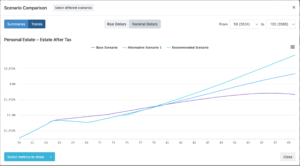
- Compare scenarios: Show outcomes with and without recommended changes, particularly highlighting the cost of inaction versus the benefits of implementation over 5, 10, and 20-year horizons
- Focus on benefits: Emphasize how strategies improve the client’s situation in terms they value most; whether that’s security, legacy, lifestyle maintenance, or specific milestone achievements
- Invite questions: Create space for clarification and discussion by pausing strategically, asking “What questions do you have?” rather than “Do you have any questions?” and validating concerns before addressing them
- Tailor complexity: Adjust the technical depth based on the client’s financial sophistication, using analogies and real-world examples to bridge knowledge gaps
- Provide summaries: End with a one-page action plan highlighting key takeaways and next steps with clear ownership and timelines
Snap Projections helps you create client-friendly visuals that make financial concepts easier to understand. The one-page SnapShot report, which can serve as a one-page financial plan template, provides a concise summary clients can easily reference.
Visual comparisons in Snap Projections, like retirement income scenarios or tax impact illustrations, can help make it easier to adapt your delivery while still covering all essential points.
Step 6: Implement the financial plan
The sixth step in financial planning involves putting recommendations into action. This stage may help transform planning into tangible results.
Create a clear implementation schedule with specific tasks, responsibilities, and deadlines. This might include:
- Opening new accounts
- Adjusting investment allocations
- Updating insurance coverage
- Revising estate documents
- Setting up automatic savings plans
You may want to coordinate with other professionals like accountants, lawyers, or insurance specialists. Advisors may wish to stay involved to ensure all elements are implemented correctly and completely.
Step 7: Monitor progress and update the plan
The final step in the financial planning process is to establish an ongoing review system. Financial planning isn’t a one-time event but a continuous process that evolves with the client’s life.
Schedule regular review meetings to:
- Update financial information
- Assess progress toward goals
- Adjust for life changes (marriage, children, career shifts)
- Respond to economic or legislative changes
- Refine strategies as needed
The last step in the financial planning process is to maintain this monitoring system throughout your client relationship. This ongoing engagement may create opportunities for deeper relationships and referrals.
Step 8: Integrate behavioural insights into planning conversations
Understanding client behaviour may be just as important as understanding their numbers. Emotions, biases, and external influences, such as finfluencer content or media headlines, often shape how clients approach planning.
During each step, try to ask open-ended questions to uncover beliefs or misconceptions. Visualizing long-term outcomes may also reframe thinking, shifting the focus from short-term reactions to long-term goals.
Snap Projections supports this by showing the “why” behind every recommendation, helping clients feel informed, not overwhelmed.
Alternative approaches to the financial planning stages
While the 7-step financial planning process is widely recognized, some practitioners use variations like the 5-step method. These condensed approaches often combine certain steps while maintaining the core progression and logic.
The 5 steps of financial planning often merge the analysis and recommendation development steps. A 6-step model might combine goal-setting with data gathering or integrate implementation with monitoring.
Regardless of the exact number of steps, effective financial planning typically includes:
- Understanding the client situation
- Establishing clear objectives
- Creating strategies to achieve those objectives
- Implementing recommendations
- Reviewing and adjusting over time
How technology enhances the financial planning process
Modern financial planning software may streamline each step in the financial planning process. Digital tools can help you gather information, analyze scenarios, and present recommendations more efficiently.
| Traditional Process | With Snap Projections |
|---|---|
| Manual calculations & spreadsheets | Automated, scenario-based modelling |
| Static visuals or verbal-only plan delivery | Visual summaries and side-by-side scenarios |
| Lengthy, static reports | Real-time updates and interactive sessions |
| Harder to scale | Efficient, repeatable client workflows |
Snap Projections helps Financial Advisors:
- Organize client data systematically
- Create visual projections that clients understand
- Compare multiple scenarios side-by-side
- Update plans in real-time during client meetings
- Generate professional reports quickly
This efficiency allows you to focus on relationship building rather than calculations. Advisors who use Snap find they are able to serve more clients effectively while delivering personalized, high-quality advice.
Support your clients and your practice with Snap Projections
A consistent planning process helps Financial Advisors support compliance, improve efficiency, and reinforce value. Each step, from data gathering to ongoing monitoring, represents an opportunity to deepen client engagement.
In today’s environment, clients often look for clarity, personalization, and responsiveness. A consistent, repeatable process supported by the right technology helps Advisors to meet those expectations while staying focused on what matters most: delivering value through strategic planning.
Snap Projections supports each phase of this process with interactive planning tools, scenario analysis, and professional reporting. Whether you’re modelling retirement income or illustrating tax implications, Snap can help make your advice more accessible.
Financial Advisors and Planners can start a 14-day free trial to experience how Snap Projections enhances every stage of your financial planning process.
FAQs about financial planning steps
What are the 5 steps in financial planning?
The 5 steps in financial planning offer a streamlined version of the traditional process. They include: understanding the client’s financial situation, setting clear goals, analyzing current financial data, developing and implementing a strategy, and reviewing the plan regularly. This approach may help Advisors deliver structured advice while maintaining flexibility for various client needs.
Why might it be helpful to follow defined financial planning steps?
A structured planning process may help ensure that different aspects of a client’s financial life, such as goal setting, risk management, and plan updates, are thoughtfully considered. It can also create a more consistent workflow, support documentation requirements, and help clients better understand how recommendations relate to their long-term objectives.
What are the 5 pillars of financial planning?
The five key pillars are: 1) Cash flow management, 2) Risk management and insurance, 3) Investment planning, 4) Retirement and goal planning, and 5) Tax and estate planning. Together, these pillars often support a holistic, long-term approach that helps Advisors build comprehensive strategies tailored to client goals.