Your client asks whether to claim their Registered Retirement Savings Plan (RRSP) deduction now or wait. The answer depends on their marginal rate, but the terms used often confuse clients. Explaining the aspects of an RRSP deduction deferment requires a framework that clients can understand.
Here, we will explore the report-now-claim-later mechanics with a Schedule 7 walkthrough and a marginal-rate framework. You will get a client-ready decision process, a partial-claim playbook, and a meeting workflow for claim-now-versus-later scenarios.
Main takeaways
- You report RRSP contributions on Schedule 7, but can defer the deduction to any future year without penalty or expiry.
- Contribution room, unused contributions, and deduction limit are three separate figures that clients and staff routinely confuse.
- Defer the deduction when your client’s marginal rate will be higher in a future year than today.
- You can claim part of a contribution now and carry forward the rest to spread benefits across tax years.
- The two most common mistakes are skipping Schedule 7 or treating undeducted contributions as fresh room.
The key rule: report now, claim later
Yes, you can defer RRSP deductions. The process has two steps:
- Report every RRSP contribution on Schedule 7 in the tax year it is made.
- Decide how much to enter as a deduction on Line 20800 (anywhere from zero to the full amount) in that year or any year after.
CRA guidance states you do not have to claim the undeducted contributions in a single year. You carry the deduction forward as long as needed. The only real constraint is choosing the year where your client’s marginal tax rate makes the deduction worth the most.
That split between reporting and claiming is a genuine planning lever. Your client locks in the contribution today and holds the deduction in reserve until it delivers the biggest tax benefit.
Stress-test bracket strategies before clients retireSee how accelerated RRIF withdrawals can change lifetime taxes and estate outcomes, so you can connect deduction timing to broader marginal-rate planning. |
How it works on the tax return (Schedule 7)
The Schedule 7 records every RRSP contribution your client made during the tax year, including amounts from the first 60 days applied to the prior year.
The deduction on Line 20800 does not have to match that total. Your client can enter a smaller figure, or nothing at all. Any gap between what was reported and what was claimed becomes an undeducted contribution that carries forward. CRA tracks that balance automatically.
After the return is assessed, the notice of assessment (NOA) and CRA My Account show an updated RRSP deduction limit. That figure equals available contribution room, plus any undeducted amounts from prior years.
Anchor every deduction-timing decision on that NOA number, not your client’s memory or a rough estimate.
Here’s a simple example:
- Your client contributes $15,000 to their RRSP in 2025.
- On their 2025 return, they report the full $15,000 on Schedule 7 but enter $0 on Line 20800.
- Their 2025 NOA shows $15,000 in undeducted contributions available for future years.
- On their 2026 return, they claim the full $15,000 on Line 20800, cutting taxable income in the higher-rate year.
Partial claims follow the same logic. If your client deducted $5,000 in 2025 and held back $10,000, the NOA would show that $10,000 as still available. The filing steps are mechanical—your value as an Advisor lies in helping the client decide how much to claim and when.
The three terms clients confuse and why it matters
Three RRSP concepts sound nearly identical but mean different things. Mixing them up in a meeting—or on a return—can lead to an overcontribution or a missed deduction.
RRSP contribution room
This is the total your client can contribute. It equals 18% of prior-year earned income up to the annual dollar limit, plus unused room from previous years. The RRSP contribution limit for 2025 is $32,490, per the CRA.
Unused RRSP contributions
These are amounts already contributed and reported on Schedule 7 but not yet claimed as a deduction. These appear as undeducted balances on the NOA.
RRSP deduction limit
This is the maximum deduction your client can take in a given year. It equals contribution room plus undeducted contributions carried forward. This is the figure on the NOA.
If someone treats undeducted contributions as fresh room and adds more money, they may exceed their actual room. That triggers the 1% monthly penalty on the excess. A quick check of the NOA before any new contribution or deduction decision removes that risk.
Present claim timing without spreadsheet guessworkCompare claim-now, claim-later, and partial-claim options with real-time, province-specific calculations your clients can follow. Evaluate whether the workflow fits your meeting style. |
When deferring makes sense: a marginal-rate decision framework
Whether to claim now or later comes down to one question: will the deduction save more tax in a future year than today? Compare your client’s current marginal rate against what you expect over the next 1–3 years.
Several situations tilt the math toward deferral. A pending raise, bonus, or promotion that pushes income into a higher bracket is the most common trigger. So is a return to full-time work after parental leave or unemployment.
Anticipated capital gains matter, too. The capital gains inclusion rate is currently 50% for most taxpayers. However, the CRA has proposed increasing it to 66.67% above certain thresholds. The deduction reduces taxable income, which may offset both ordinary income and the realized capital gains included in taxable income.
On the other hand, if the marginal rate is already at or near its peak, claiming now removes the risk that tax-law changes or life events erode the value of waiting.
The table below uses hypothetical combined federal/provincial rates for general guidance. Your client’s province, credits, and income mix will shift the exact numbers.
Situations that can influence deferment
| Scenario | Current marginal rate | Expected future rate | Recommended approach |
|---|---|---|---|
| Large rate jump expected | ~30% | ~43% | Defer all or most of the deduction |
| Rate stays flat | ~40% | ~40% | Claim now—no benefit to waiting |
| Moderate rate increase | ~33% | ~43% | Claim enough to reach the bottom of the current bracket, defer the rest |
This framework is a starting point for client conversations, not individual tax advice.
How to compare “claim now vs. later” with a client
Confirm your client’s current-year taxable income and marginal rate using their NOA and most recent pay info. Then, estimate next year’s expected income, including salary, bonus, capital gains, pension, or other sources.
Build two scenarios and compare the year-by-year tax impact:
- Scenario A: claim the full RRSP deduction this year and show the after-tax result.
- Scenario B: defer the deduction to next year and show the after-tax result.
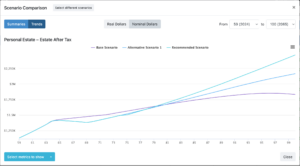
A planning platform like Snap Projections’ tax planning software can model both scenarios, showing how taxable income shifts so your client sees the tradeoff clearly. Document the rationale for whichever approach you recommend.
Showing clear, province-specific tax calculations in real time builds client confidence. That same output gives you a compliance-ready record of the recommendation.
Partial-claim strategies and multi-year sequencing
The CRA lets you claim a portion of your reported RRSP contribution now and carry forward the rest as unused RRSP deductions. That opens up three practical multi-year patterns.
Claim none now, all later
This works best when current-year income is unusually low, such as from parental leave, a sabbatical, or being early in their career. A meaningful income jump is on the horizon, so the entire deduction stays banked for the higher-rate year.
Claim enough to hit a target bracket, defer the rest
Your client deducts just enough to pull taxable income down to a lower bracket threshold this year. The remaining amount carries to a year when it offsets income taxed at a steeper rate.
Smooth over two to four years
When income is climbing gradually, spreading the deduction across several returns trims the top marginal rate each year, instead of concentrating the benefit in one.
Scenario modelling helps you document why you split the deduction, which strengthens your compliance file. Financial planning software for Advisors that shows year-by-year tax projections makes this comparison easy to present and explain.
Common mistakes when deferring RRSP deductions
Choosing to defer a deduction is fully permitted and carries no penalty. Overcontributing is a different story. Four mistakes account for most of the confusion Advisors face.
Skipping the Schedule 7 filing
Even when your client plans to claim zero deduction this year, the contribution must still appear on Schedule 7 for the year it was made. Without that filing, the CRA has no record of the undeducted amount. The deduction could be lost entirely, or a reassessment could follow later.
Treating the contribution deadline as a deduction deadline
Under the first-60-days rule, RRSP contributions made early in the calendar year can apply to the prior tax year’s return. For 2025, the RRSP cut-off is March 2, 2026, per CRA.
That deadline controls when the contribution qualifies, not when the deduction must be taken. A client who contributes in February 2026 can report it on their 2025 Schedule 7 and still defer the deduction to 2026 or later.
Confusing deferral with over-contribution
These two concepts look similar on the surface but carry very different consequences.
Deferring a deduction: Your client contributed within their available room, reported the contribution on Schedule 7, and chose to claim the deduction in a future year. No penalty applies.
Over-contributing: Your client contributed more than their available RRSP contribution room, beyond the $2,000 lifetime buffer. CRA charges a 1% per-month tax on the excess until it is withdrawn or absorbed by new room. File T1-OVP.
If there’s any doubt about staying within the limit, confirm available room on the NOA or CRA My Account before the money goes in.
Losing track of carry-forward balances
Undeducted contributions build up on the NOA. Without regular checks, it is easy to forget how much deduction room is sitting there. That leads to missed deductions or accidental over-contributions when new money is added.
The NOA remains the single source of truth for both contribution room and undeducted amounts.
Having a repeatable, documented process helps avoid mistakes or omissions.
Run claim-now vs. later scenarios fastBuild and document an RRSP deduction sequence that targets brackets across multiple years, then share the results immediately after the meeting. Financial Advisors and Planners can start a 14-day free trial |
Model RRSP deduction timing with Snap Projections
Snap Projections lets you build “claim now” and “claim later” scenarios side-by-side during a single meeting. Your client sees exactly how taxable income and marginal rates shift year over year.
The tax tradeoff becomes visible, the rationale is documented, and the conversation moves from uncertainty to a confident decision. No follow-up meetings or manual recalculations needed.
Financial Advisors and Planners can start a 14-day free trial and turn RRSP deduction timing into a documented, repeatable strategy your clients understand and trust.
FAQs about deferring RRSP deductions
Can you defer RRSP deductions?
Yes, you can defer RRSP deductions. Whether it makes sense to do so comes down to one question: Will the deduction save more tax in a future year than today?
Should I defer my RRSP deduction if I’m planning to take parental leave next year?
Generally, no; claim the deduction this year while your income and marginal rate are higher. Parental leave income will likely put you in a lower bracket, so claiming now saves more tax per dollar deducted.
However, if you expect a big bonus or capital gain when you return to work, model both scenarios to confirm timing.
How do I know if deferring will actually save my client tax, or if I’m overthinking it?
Build two scenarios (claim now and claim later) and compare the after-tax result year by year. If the marginal-rate gap is less than one bracket, the savings may not justify the complexity.
Use the client’s NOA and projected income to estimate rates. A jump from roughly 30% to roughly 43% justifies deferral. Document the comparison so you can revisit it if things change.
If I use planning software to model deferred deductions, what inputs do I need to prepare before the meeting?
Gather the client’s current-year NOA (for contribution room and undeducted amounts), latest pay stub or T4 (for current income), and estimates for next year’s salary, bonus, or capital gains.
Confirm the RRSP deduction limit and any existing undeducted contributions from the NOA to avoid overcontribution errors.