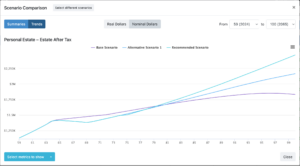
Many clients already understand the basics of spousal RRSPs. What holds them back is uncertainty. Attribution timelines can feel abstract and withdrawal tax results feel unpredictable. Without clear side-by-side modelling, clients are not sure the strategy actually saves household tax.
When you measure household tax impact, apply suitability filters, and compare scenarios visually, that hesitation fades. Clear timelines and trade-offs help clients see what’s happening and make confident decisions.
Main takeaways
- Spousal RRSP contributions use the contributor’s room while the annuitant spouse owns the account.
- The three-year attribution rule taxes withdrawals to the contributor if made too soon after contributions.
- RRIF minimum withdrawals are exempt from attribution regardless of when spousal contributions were made.
- Spousal RRSPs provide income-splitting flexibility before age 65 when pension splitting is unavailable.
- Model three scenarios—baseline, spousal RRSP, and TFSA-first—to quantify household tax impact clearly.
Spousal RRSP basics
A spousal RRSP is an RRSP set up for a spouse or common-law partner. One spouse is the contributor. They use their own RRSP room. The other spouse is the annuitant, who owns the account and controls withdrawals.
Ownership matters. Even though one spouse funds the account, the annuitant controls when and how money comes out.
Who contributes and who owns the account
Spousal RRSP contributions use the contributor’s RRSP deduction limit, not the annuitant’s. The same caps and deadlines apply as with personal RRSPs.
- Contributions reduce the contributor’s room, not the annuitant’s.
- The RRSP dollar limit is $31,560 for 2024, $32,490 for 2025, and $33,810 for 2026.
- The personal limit is the lesser of 18% of prior-year earned income or the annual cap, minus any pension adjustment.
You can contribute to a spousal RRSP until December 31 of the year the annuitant turns 71. This applies even if the contributor has already converted their own RRSP to a RRIF. That extra time can extend income-splitting opportunities for higher earners.
Pension adjustments and RRSP room
Defined benefit and defined contribution pensions reduce RRSP room through pension adjustments. With YMPE rising to $71,300 in 2025 and $74,600 in 2026, and YAMPE rising to $81,200 in 2025 and $85,000 in 2026, pension adjustments may increase faster than expected.
Before funding a spousal RRSP:
- Confirm the contributor’s RRSP room on their latest Notice of Assessment or CRA My Account.
- Estimate upcoming pension adjustments if the contributor is still accruing benefits.
- Contribute only from confirmed room to avoid over-contribution penalties.
The three-year attribution rule
Attribution applies when a withdrawal occurs in the same calendar year as a contribution, or in either of the two prior calendar years. If that happens, the withdrawal is taxed to the contributor, up to the amount contributed during that window.
Key points to remember:
- The test looks at calendar years, not exact dates.
- The window covers the withdrawal year (Y), plus Y-1 and Y-2.
- Each new contribution resets the window.
- All spousal RRSPs for the same annuitant are included, not just the account the withdrawal came from.
Direct RRSP withdrawals can trigger attribution. RRIF withdrawals above the minimum can also trigger it. RRSP-to-FHSA transfers that are deemed taxable may trigger it as well.
RRIF minimum withdrawals are exempt from attribution, no matter when contributions were made.
Make household planning easier to followSpousal RRSP choices often come down to trade-offs across years, not one tax season. A clear planning structure helps clients stay confident in the plan. |
Spousal RRSP attribution timeline checklist
Before any withdrawal:
- Track contributions made in the current year and prior two years.
- Confirm whether withdrawals will be taxed to the contributor or the annuitant.
- Document the result using Form T2205 to support correct reporting.
Timeline examples that show when attribution applies
- Early-year contribution scenario: You contribute $10,000 in January 2024. Your spouse withdraws $5,000 in March 2027. Three full calendar years have passed (meaning the withdrawal is after the 3-year attribution window) so the withdrawal is taxed to your spouse.
- Late-year contribution scenario: You contribute $10,000 in December 2024. Your spouse withdraws $5,000 in February 2026. Only one full calendar year has passed, so the withdrawal is attributed back to you.
- Repeated annual contributions: You contribute $8,000 each January from 2023 through 2025. Your spouse withdraws $15,000 in 2026. Contributions from 2024 and 2025 are still in the window, so the full $15,000 is attributed to you.
Withdrawals and tax coordination
Before clients take money out, confirm attribution exposure, explain withholding versus actual tax, and coordinate timing with other income sources.
Before a client withdraws
- Confirm contribution dates in Y, Y-1, and Y-2.
- Calculate the attributed portion, if any.
- Document the split using Form T2205 to support filing.
Withholding tax vs. final tax
For Canadian residents, withholding rates are:
- 10% on withdrawals up to $5,000
- 20% on $5,001 to $15,000
- 30% above $15,000
Quebec rates are 5%, 10%, and 15%.
Withholding often under-collects compared to the marginal tax rate. That rate could belong to the contributor or the annuitant, depending on attribution. Prepare clients for a possible balance owing at tax time.
Timing with CPP, OAS, and pensions
Withdrawals are often most effective in years when the annuitant has lower income. This may be early retirement or years before CPP or OAS begins.
If the contributor faces OAS recovery tax risk, avoiding attribution becomes critical. OAS clawback thresholds are $90,997 for 2024, $93,454 for 2025, and $95,323 for 2026. Keeping income off the higher earner’s return can preserve benefits.
First-60-days contributions and attribution risk
First-60-days contributions may count for the prior tax year, but they still count in the current year for attribution. A February 2026 contribution can affect withdrawals through 2028.
If a withdrawal is planned soon, you may want to consider pausing new contributions and clearly document the trade-off.
When a spousal RRSP makes sense
Spousal RRSPs can be effective, but they are not universal. Results depend on income gaps, timing, and competing strategies.
Best-fit situations
They tend to work best when one spouse earns significantly more and the lower-income spouse withdraws at a lower marginal rate. They are especially valuable before age 65, when pension income splitting is not yet available.
Holding assets in the lower-income spouse’s name can also reduce retirement tax and limit OAS clawback for the higher earner.
When it is not worth it
The three-year rule adds tracking and limits flexibility. Early withdrawals can shift tax unexpectedly. Ownership also matters—the annuitant controls the funds, which can become an issue if goals change or relationships break down.
TFSAs now receive more annual contributions than RRSPs, reflecting demand for flexibility. After age 65, up to 50% of eligible pension income, including RRIF withdrawals, can be split, which may reduce the incremental value of a spousal RRSP.
Three example scenarios Advisors can model
- Scenario A (baseline): Both spouses fund only their own RRSPs; no spousal contributions.
- Scenario B (spousal RRSP): Higher earner redirects a portion of contributions to the lower earner’s spousal RRSP.
- Scenario C (TFSA-first or hybrid): Prioritize TFSA room for the lower earner; use spousal RRSP only after TFSA is maximized.
Compare these outputs across scenarios:
- Household marginal tax rate in each retirement year.
- OAS clawback exposure per spouse.
- Total after-tax retirement income over the projection period.
Model spousal RRSP tax outcomes side by sideShow how spousal RRSPs affect household tax, attribution, and OAS clawback using clear, client-friendly projections. |
A repeatable workflow for modelling spousal RRSP scenarios
Start by confirming inputs. Then run the three default scenarios outlined above to show household tax impact side by side. This approach demonstrates value quickly and avoids hours of manual work.
Inputs to confirm include:
- Current and projected earned income for each spouse
- Retirement ages and any staggered retirement plans
- Pension eligibility and expected pension income
- Existing RRSP and RRIF balances and near-term liquidity needs
When presenting results, show year-by-year household tax payable, highlight marginal rate differences, and flag OAS clawback exposure. Use plain language so clients understand the impact of their choices.
Tie projected tax savings to real outcomes, like lifestyle spending, gifting, or legacy goals. Document assumptions clearly to support compliance.
Admin and reporting
Confirm which spouse receives each receipt and tax slip, and how each item will be reported. Getting that straight early can help avoid admin confusion when attribution, transfers, or withdrawals come up.
Transfers and ownership rules
RRSPs cannot be re-registered to a new annuitant. Transfers are allowed only on relationship breakdown under a formal agreement, or on death to a surviving spouse.
When clients ask about transfers, clarify the real goal. They may be looking for future spousal contributions, a spousal loan strategy, or asset division.
Joint RRSPs do not exist
Each RRSP has one annuitant. A spousal RRSP is not joint, even if funded by the other spouse. The annuitant owns and controls the account.
Receipts, slips, and reporting
- Contribution receipts are issued in the contributor’s name, and the contributor claims the deduction.
- Withdrawal slips are issued in the annuitant’s name.
- When attribution applies, Form T2205 is used to shift income and withholding credits to the correct spouse and avoid double taxation.
Home Buyers’ Plan and the 89-day rule (also called the “RRSP wash rule”)
The Home Buyers’ Plan limit increased to $60,000 as of April 16, 2024. A temporary three-year repayment deferral applies to first withdrawals made between January 1, 2022 and December 31, 2025.
Contributions made to an RRSP within 89 days before an HBP withdrawal generally cannot be claimed as a deduction if those same contributions are withdrawn under the HBP. To help keep the contribution deductible, it can be completed at least 90 days before the planned withdrawal—whether the RRSP is spousal or personal.
Run a spousal RRSP comparison with Snap ProjectionsCompare scenarios side by side to show how spousal RRSP contributions can affect household tax, attribution exposure, and OAS recovery tax risk across retirement years.
|
Model spousal RRSP strategies faster with Snap Projections
This article covered CRA contribution and attribution rules, a pre-withdrawal checklist, and a three-scenario comparison approach. These resources help position spousal RRSPs accurately, show when they save tax versus TFSAs or pension splitting, and help avoid attribution surprises.
Snap Projections converts these checklists and scenario steps into repeatable client meetings. Confirm inputs, then run the three comparisons. Show year-by-year household tax impact side by side. Advisors use it to measure OAS clawback exposure, show marginal rate differences across retirement years, and present attribution timelines clearly. Clients then understand the trade-offs and as the Advisor, you can also document assumptions for the file.
Financial Advisors and Planners can start a 14-day Free Trial to reduce prep time and show real tax impact in minutes.
FAQs about spousal RRSPs
Can both spouses contribute to each other’s spousal RRSPs in the same year?
Yes. Each spouse can contribute using their own room. Each contributor-annuitant pair has its own attribution window.
What happens to spousal RRSP attribution if we separate or divorce?
Attribution still depends on contribution dates. Relationship status does not change the rule. The window resets only when funds are divided formally. This must be under a court order or written agreement.
If my client’s spouse withdraws from a spousal RRSP to pay off debt, who pays the tax?
If contributions were made in Y, Y-1, or Y-2, the contributor reports it. If not, the annuitant reports the withdrawal.
Can I use a spousal RRSP contribution to reduce my client’s over-contribution penalty?
No. Spousal RRSP contributions use the contributor’s room. They do not fix an over-contribution in the annuitant’s RRSP.
How do I size spousal RRSP contributions for a client with a defined-benefit pension?
Start with the contributor’s RRSP limit on the NOA. Subtract the expected pension adjustment. Contribute only the net available room.
Can my client transfer an existing RRSP balance into a spousal RRSP?
No. You cannot transfer funds to a different annuitant. Exceptions apply only on relationship breakdown or death.
What if my client needs to withdraw from a spousal RRSP for a Home Buyers’ Plan purchase?
HBP withdrawals are exempt from attribution. But recent contributions may not be deductible. This applies to contributions within 89 days before withdrawal.
Does attribution apply if my client converts a spousal RRSP to a spousal RRIF and takes only the minimum withdrawal?
No. RRIF minimum withdrawals are exempt from attribution. This is true regardless of contribution timing. Attribution applies only above the minimum.
When is a spousal RRSP not the right fit for my client?
Skip spousal RRSPs when the income gap is small. Also skip them when liquidity needs raise attribution risk. It may also be unnecessary when post-65 pension splitting already equalizes income.