

Many clients miss out on thousands in tax-free savings because they don’t fully understand how the TFSA contribution limit works. Even small mistakes, such as re‑contributing too early or guessing contribution room, can lead to penalties or lost growth.
As a Financial Advisor, helping clients use their TFSA correctly is one of the easiest ways to protect their savings. When you understand the rules, you can help clients avoid costly errors, make smarter contribution decisions, and grow more tax‑free wealth year after year—especially as limits increase over time.
Main takeaways
- TFSA limits increase every year, and unused room carries forward, giving clients more chances to save tax‑free over time.
- Clients should check their exact TFSA room using CRA My Account to avoid over‑contributing and paying penalties.
- Withdrawn TFSA amounts can only be re‑contributed in the next calendar year, and putting money back too soon can lead to monthly penalties.
- TFSA strategies should match each client’s life stage, from early savings to retirement income planning.
- Snap Projections helps Advisors track TFSA limits and model growth, making it easier to plan and avoid costly mistakes.
What is the TFSA and why is it so valuable?
The Tax-Free Savings Account (TFSA) is a special Canadian account that helps your clients grow their money without paying tax on the earnings. All interest, dividends, and capital gains earned in a TFSA are tax-free—even when withdrawn.
Any Canadian resident with a valid SIN can open a TFSA starting January 1 of the year they turn 18. For example, someone born in 2003 became eligible to contribute in 2021.
Because withdrawals are not taxed, the TFSA can be used for short-term savings, emergency funds, or long-term retirement goals. It’s one of the most flexible tools available to your clients.
Key TFSA benefits:
- Tax-free growth on investments (no tax on earnings)
- Withdraw any time, for any reason—no taxes or penalties
- Generally do not affect income-tested benefits, including OAS or GIS
- Withdrawals are added back to contribution room the next calendar year
Unlike RRSPs, TFSA withdrawals are never taxed and don’t trigger benefit clawbacks. This makes them ideal for flexible retirement income planning, especially for clients who may face OAS or GIS reductions. Unlike RRSPs, TFSAs have no required withdrawals or age-based limits.
Advisor tipHelp clients understand that TFSA contribution room is a lifetime asset. Even if they can’t maximize contributions now, tracking their available room ensures they can take full advantage later. |
Help clients make informed planning decisionsUse Snap’s Financial Planner Toolkit to support goal-based planning conversations with templates, checklists, and best practices tailored for Canadian Financial Advisors. |
How the TFSA contribution limit works
The TFSA contribution limit represents the maximum amount you can deposit across all your TFSAs. This limit accumulates yearly and carries forward indefinitely.
Annual TFSA contribution limits (2009–2025)
The TFSA was introduced in 2009, and the annual contribution limits have varied:
- 2009–2012: $5,000 per year
- 2013–2014: $5,500 per year
- 2015: $10,000
- 2016–2018: $5,500 per year
- 2019–2022: $6,000 per year
- 2023: $6,500
- 2024–2025: $7,000 per year
For someone eligible since 2009, the total cumulative TFSA contribution limit by 2025 will be $102,000. The TFSA limit for 2024 was $7,000, and remains at this level through 2025.
The table below shows how the annual TFSA limits have accumulated over time, helping Advisors quickly see how contribution room builds year by year for long-term eligible clients.
TFSA contribution limits by year
| Year | Annual Limit | Cumulative Total |
|---|---|---|
| 2009 | $5,000 | $5,000 |
| 2010 | $5,000 | $10,000 |
| 2011 | $5,000 | $15,000 |
| 2012 | $5,000 | $20,000 |
| 2013 | $5,500 | $25,500 |
| 2014 | $5,500 | $31,000 |
| 2015 | $10,000 | $41,000 |
| 2016 | $5,500 | $46,500 |
| 2017 | $5,500 | $52,000 |
| 2018 | $5,500 | $57,500 |
| 2019 | $6,000 | $63,500 |
| 2020 | $6,000 | $69,500 |
| 2021 | $6,000 | $75,500 |
| 2022 | $6,000 | $81,500 |
| 2023 | $6,500 | $88,000 |
| 2024 | $7,000 | $95,000 |
| 2025 | $7,000 | $102,000 |
CRA formula for calculating contribution room
The TFSA contribution room calculation follows a simple formula:
Available TFSA room = Starting room for the year + Prior-year withdrawals − Current-year contributions
Your contribution room starts accumulating when you turn 18 and are a Canadian resident. If you were born in 1993, you would be 30 in 2023 and eligible for the contribution room since 2011.
The maximum contribution for TFSA depends on your eligibility period. To determine TFSA contribution room accurately, add all annual limits since you became eligible, subtract what you’ve already contributed, and add back any withdrawals from the previous year.
Where clients can check their TFSA contribution room
The most reliable way to verify TFSA contribution room is through the Canada Revenue Agency’s “My Account” portal. This shows the official contribution room as of January 1 of the current year, based on information reported to the CRA. It may not reflect very recent contributions or withdrawals.
The CRA also provides a TFSA Transaction Summary showing all contributions, withdrawals, and any over-contribution penalties. This is especially important if your clients have multiple TFSA accounts at different institutions.
For clients who want to calculate future scenarios, a TFSA contribution limit calculator can help project available room based on planned contributions and withdrawals.
Important TFSA withdrawal rules and re-contribution timing
One of the most common mistakes with TFSAs is misunderstanding how withdrawals affect contribution room. When your client takes money out of their TFSA, they can’t put it back in until January 1 of the following year—even if they didn’t use all their room.
Many clients think they can treat a TFSA as a regular savings account and just replace what they took out. But re-contributing too early can cause penalties if they’ve already used up their annual limit.
How TFSA withdrawal timing works:
- Your client withdraws $10,000 in March 2024
- They must wait until January 1, 2025 to re-contribute that $10,000
- If they had already contributed the full 2024 limit of $7,000, putting the $10,000 back in 2024 would create a $10,000 over-contribution
- On January 1, 2025, they get new contribution room:
$10,000 (withdrawal) + $7,000 (2025 limit) = $17,000 total room
What happens if they over-contribute?
The CRA charges a 1% monthly penalty on the extra amount. This continues until they withdraw the extra or new room becomes available the next year.
Example: If your client over-contributes $5,000 and leaves it in for six months, they’ll owe: $5,000 × 1% × 6 months = $300 in penalties
3 TFSA strategies by client profile
TFSAs work differently depending on your client’s age, income, and financial goals. Here are three common strategies based on life stage:
1. Younger clients and accumulation stage
Young clients (under 30) often earn less and may not benefit as much from RRSP deductions. The TFSA is a great starting point for flexible, tax-free savings.
Strategy tips:
- For clients with lower income (often under $50,000), a TFSA is often more effective than an RRSP, since the immediate tax deduction from RRSP contributions may be limited.
- Start an emergency fund in the TFSA—clients can withdraw funds tax-free anytime without losing contribution room forever
- Invest for growth (ETFs or stocks) so gains and dividends grow tax-free
- Encourage regular deposits, even small ones—this builds strong saving habits and benefits from dollar-cost averaging
2. Mid-career professionals with surplus income
Clients in their 30s to 50s with incomes over $75,000 often have more income to invest. TFSAs are a great complement to RRSPs during peak earning years.
Strategy tips:
- Balance RRSP and TFSA contributions—use RRSPs for the tax deduction now, and TFSAs for flexibility later, especially if clients expect high taxable income in retirement
- Use the TFSA for higher-growth investments—this may include small-cap stocks or sector funds that can grow tax-free
- Plan to reduce OAS clawbacks—TFSA withdrawals don’t count as taxable income, so they won’t reduce benefits as RRSP withdrawals can
- Save for medium-term goals—including renovations, children’s education, or other large purchases where RRSP withdrawals would be taxed
Strategy insightFor clients with maximized RRSPs who still have investable income, the TFSA offers additional tax-sheltered growth without the forced withdrawal requirements of RRIFs. The 2025 TFSA contribution limit provides another $7,000 of room to protect investment returns from taxation, and couples can effectively shelter $14,000 annually. |
3. Pre-retirees and retirees
Older clients (usually 55 and up) can use the TFSA to manage taxes and protect government benefits. Unlike RRSPs or RRIFs, TFSA withdrawals are not taxable and don’t affect benefits, including OAS or GIS.
Retirement TFSA strategies:
- Take money from taxable accounts or RRSPs first, and let the TFSA grow—this reduces taxes early and boosts long-term, tax-free savings
- Move RRSP withdrawals into the TFSA when income is low (before CPP or OAS starts)—this keeps the money sheltered from taxes in the future
- Use TFSA for estate planning—it can pass tax-free to a spouse or beneficiary when structured correctly (for example, by naming a successor holder). RRSPs are generally taxable at death unless rolled to an eligible spouse or partner
- Use TFSA withdrawals to stay in a lower tax bracket or avoid OAS clawbacks in high-income years
- Coordinate TFSA and pension income splitting—this can lower household taxes and stretch retirement savings further
TFSAs also help retirees avoid unexpected tax spikes from RRIF withdrawals or investment income. This is especially useful for clients trying to stay below the OAS clawback threshold or preserve GIS eligibility.
Visualize TFSA contribution strategies with precisionSnap Projections helps Advisors track contribution room, model optimal drawdowns, and compare multi-year savings strategies—all in one place. |
TFSA over-contributions and how to avoid them
TFSA over-contributions happen when a client puts more money into their account than they are allowed. This often comes from confusion about how withdrawals and re-contributions work.
How over-contributions happen
The most common mistake is recontributing money in the same year it was withdrawn. TFSA rules say that when you take money out, you don’t get that room back until January 1 of the next year.
If a client takes out $8,000 in June, they can’t put that $8,000 back until the next calendar year. If they do, and they’ve already hit their limit, they’ll face a 1% penalty each month on the extra amount.
Example: A $5,000 over-contribution kept for six months means $300 in penalties ($5,000 × 1% × 6 months).
Common over-contribution scenarios:
Here are four common ways clients accidentally over-contribute:
- Withdrawing and recontributing too soon: A client puts in $7,000 (the full limit), withdraws $4,000 in March, then tries to put that $4,000 back in September. That’s an over-contribution.
- Guessing their contribution room: Clients who haven’t tracked their past deposits or started mid-year might assume they have full room, when they don’t.
- Using multiple TFSAs at different banks: Contribution limits apply to all TFSAs combined, not per account. Without tracking, it’s easy to go over.
- Misunderstanding investment growth: Gains inside the TFSA don’t count toward your limit. If a client’s TFSA grew, they can’t use the larger balance as new room.
Re-contribution example
A client maxes out their TFSA in January 2024. In April, they withdraw $15,000 for a home renovation. In October, they receive an inheritance and want to put that $15,000 back into their TFSA.
If they do this in 2024, it’s an over-contribution. They need to wait until January 1, 2025, when that $15,000 withdrawal becomes new room—plus they’ll get another $7,000 in 2025 contribution room.
Show the long-term power of tax-free savingsStart a free trial to see how Snap Projections simplifies TFSA planning across every client scenario. |
Optimize tax-free savings strategies with Snap Projections
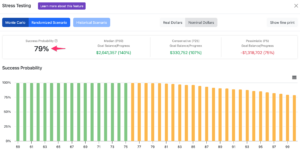
Snap Projections helps Advisors build clear and accurate TFSA plans. It tracks how much a client can contribute each year, shows how withdrawals affect future room, and models tax-free growth over time.
You can also use Snap to test different contribution and withdrawal strategies. This helps clients understand how their TFSA fits into their overall retirement and savings plan.
Snap also supports automatic TFSA top-up planning. This feature helps you model consistent annual contributions to fully utilize available room without exceeding limits.
By using visuals and real-time projections, Snap makes complex rules easier to explain. It also reduces the risk of contribution mistakes and missed opportunities. With smarter TFSA planning, you can help clients grow their savings faster and protect more of their income from tax.
Start a 14-day free trial to see how Snap Projections can help you explain TFSA planning and opportunity with more clarity and confidence.
FAQs about TFSA contribution limits
How can I tell if a client has unused TFSA contribution room?
Encourage clients to check their official contribution room through the CRA’s My Account portal. This is the most accurate source based on filed tax returns and reported TFSA transactions.
Is there a lifetime cap on TFSA contributions for clients?
No fixed lifetime limit exists. Instead, annual contribution room accumulates over time. For example, eligible clients who turned 18 in 2009 will have $102,000 of cumulative room by 2025.
Can clients contribute more than $100,000 to a TFSA?
Potentially—if they’ve accumulated enough contribution room based on eligibility and past activity. Always confirm contribution history before recommending large deposits to avoid over-contributions.
How does the TFSA contribution room reset after a withdrawal?
Withdrawals made from a TFSA are added back to the client’s contribution room on January 1 of the following year. Advisors should caution against same-year re-contributions unless verified room exists.