


A financial projection can give clients a clear picture of where they may be headed. But there is an important difference between showing that a financial plan works under a specific set of assumptions and understanding how well that plan can withstand uncertainty.
Markets won’t deliver the same return every year. Inflation can change. Poor returns can arrive at particularly inconvenient times. And the next 30 years probably won’t unfold exactly like the previous 30.
This is where financial plan stress testing and Monte Carlo analysis can create additional value.
By testing a client’s projection against randomized returns, historical data and different scenarios, Financial Advisors can move beyond asking, “Does the plan work?”
They can start asking a potentially more useful question:
“How resilient is this plan if things don’t go as expected?”
Why a traditional financial projection is only the starting point
Financial projections require assumptions.
An Advisor might use assumptions for investment returns, inflation, life expectancy, spending and other variables to create a long-term projection.
That’s useful. Clients need a baseline to understand how today’s decisions could affect their future.
But a baseline projection shouldn’t necessarily be the end of the planning process.
For example, a retirement projection could assume a particular average annual investment return. Over several decades, the portfolio might actually achieve something close to that average.
The problem is that clients don’t experience an average.
They experience individual years.
A significant market decline early in retirement can have a very different impact than the same decline occurring much later. This is sequence-of-returns risk, and it is one example of why testing different paths can add important context to a financial projection.
What does stress testing a financial plan mean?
Stress testing involves deliberately changing the conditions around a financial projection to see how the plan responds.
Instead of simply presenting the expected scenario, an Advisor can explore questions such as:
What happens if investment returns are lower than expected?
What if inflation is higher?
What if poor returns occur early in retirement?
How would this plan have performed through difficult historical periods?
What happens across hundreds or thousands of different potential return sequences?
These aren’t predictions.
The Advisor isn’t trying to determine exactly what will happen. The purpose is to understand where the financial plan may be vulnerable and where it appears resilient.
That distinction can lead to much more productive client conversations.
Use historical data to put a financial plan in context
Historical stress testing provides one way to challenge a projection.

Apply Historical rates of return and inflation to your base projections to start better planning conversations.
Instead of asking clients to imagine an abstract market downturn, an Advisor can examine how the plan responds to actual historical sequences of investment returns and inflation.
The question becomes:
“What would have happened if you had retired during a particularly difficult period?”
Historical data can make risk more tangible because the conditions being tested actually occurred.
It can also illustrate an important concept: two clients with identical portfolios and spending needs could experience very different retirement outcomes depending on when they retire and the sequence of returns they encounter.
But historical stress testing also has a limitation.
The future doesn’t have to repeat the past.
That’s where Monte Carlo analysis can provide another perspective.
Use Monte Carlo analysis to explore many possible paths
Monte Carlo analysis in financial planning allows Advisors to test a projection using many different potential sequences rather than relying on one straight-line assumption or one historical period.
The result is often expressed as a probability of success: the percentage of simulations in which the client’s goals were successfully funded.
That number can be useful—but it shouldn’t necessarily be treated as the objective of the exercise.
The real opportunity is to use the result to explore the plan.
If the probability is lower than the client is comfortable with, what could they change?
If it is high, could there be room to accomplish more?
What happens when the Advisor compares several possible strategies?
Monte Carlo analysis can turn uncertainty from something vague into something Advisors and clients can discuss.
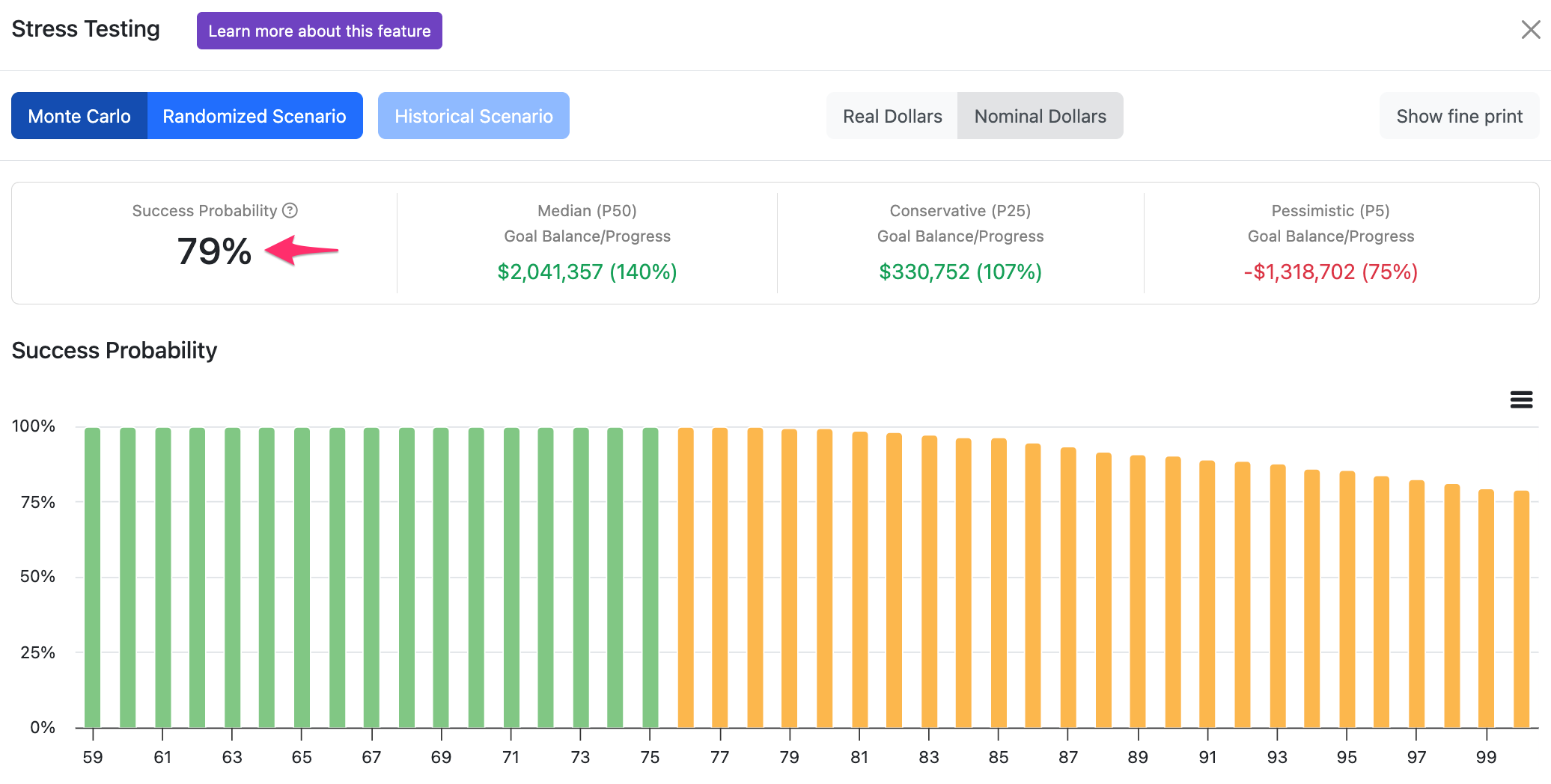
Getting the Success Probability Score is just the first step in having better client conversations and helping create better outcomes.
Advisors can try Monte Carlo analysis software absolutely free for 14 days
Canadian Financial Advisors, Planners, and Investment Managers are eligible to start a 14-day Free Trial of Snap Projections financial planning software. Stress Testing, which includes Monte Carlo, Randomized, and Historical Scenarios, is a paid add-on that is provided at no extra cost during your 14-day Free Trial.
Historical stress testing and Monte Carlo analysis answer different questions
Rather than viewing historical stress testing and Monte Carlo analysis as competing approaches, Advisors can use them to examine the plan from different perspectives.
Historical analysis asks:
“How would this plan have performed under conditions that actually happened?”
Monte Carlo analysis asks:
“How does this plan perform across many possible sequences of returns?”
Scenario comparison asks:
“What could we change if we aren’t comfortable with the outcome?”
Together, these approaches help move the planning process from projection to preparation.
Watch the Monte Carlo financial planning tutorial
A simple framework: Stress, identify, adjust
Advisors can think about financial plan stress testing as a three-step process.
1. Stress the plan
Test the client’s projection against conditions that differ from the baseline assumptions.
That might include historical data, randomized returns or alternative planning scenarios.
2. Identify vulnerabilities and opportunities
Look at what changes.
Does the plan become vulnerable when poor returns occur early?
Does a relatively small reduction in returns materially change the outcome?
Or does the client’s financial position remain strong across a wide range of scenarios?
Stress testing can reveal opportunities as well as risks.
3. Adjust what the client can control
Once the Advisor understands where the plan is sensitive, the conversation can move toward action.
A client might consider:
- adjusting retirement spending;
- saving more before retirement;
- changing their retirement date;
- reconsidering a large discretionary purchase;
- reviewing their investment strategy; or
- adjusting other financial planning decisions.
The objective isn’t necessarily to eliminate uncertainty. That’s impossible.
It’s to understand the choices available if conditions change.
Stress testing can create positive conversations too
There’s a tendency to associate stress testing with bad news.
But sometimes the opposite happens.
Perhaps a client is afraid to retire because they’re worried about running out of money. Or they have accumulated significant assets but remain reluctant to spend them.
If the projection remains resilient across difficult historical periods and many randomized return sequences, that information could create an entirely different conversation.
Could the client retire sooner?
Travel more?
Spend more during the active years of retirement?
Gift money to family while they’re alive to see the impact?
A stronger financial plan isn’t necessarily one that leaves the largest possible estate.
It’s one that helps support the client’s actual priorities.
Move the client conversation from prediction to preparation
Financial planning can’t remove uncertainty.
And a sophisticated projection shouldn’t create the impression that it can.
Instead, stress testing can help Advisors acknowledge uncertainty while giving clients a structured way to prepare for it.
A baseline projection can show the client where they’re headed if the assumptions unfold as expected.
Historical stress testing can show how the plan responds to difficult conditions we’ve experienced before.
Monte Carlo analysis can explore many potential future return sequences.
Scenario comparison can then help answer the most important question:
“What could we do about it?”
That is where the Advisor’s value becomes clear.
The objective isn’t to predict the future perfectly. It’s to help clients understand uncertainty, identify vulnerabilities and opportunities, and make informed decisions while they still have choices.


