


Artificial intelligence is rapidly finding its way into financial planning practices, and tools like ChatGPT can be incredibly useful for drafting communications, summarizing information, brainstorming ideas, and automating repetitive tasks.
But should ChatGPT be used to actually create financial plans and generate client recommendations?
FP Canada’s Standards of Professional Responsibility place clear obligations on CFP® professionals to understand the methodologies, assumptions, inputs, and outputs behind the technology they use. When viewed through that lens, relying on a large language model like ChatGPT to generate financial planning recommendations creates significant challenges for meeting those professional standards.
Here’s why.
Why using ChatGPT to create financial plans may conflict with FP Canada’s Professional Standards
Artificial intelligence is transforming nearly every profession, and financial planning is no exception.
Tools like ChatGPT can summarize documents, draft emails, explain complex concepts, and help automate many administrative tasks. These capabilities can save Advisors and Planners significant time.
However, there is an important distinction between using AI to support the financial planning process and using AI to generate financial planning recommendations.
FP Canada’s Standards of Professional Responsibility place clear obligations on CFP® professionals regarding the technology they use. In particular, Rule 29 requires Certificants to understand, validate, and take responsibility for the methodologies, assumptions, inputs, and outputs that influence financial planning recommendations.
When examined through the lens of Rule 29, relying on ChatGPT to create financial plans presents several challenges.
The CFP and QAFP professionals remains responsible
One of the most important principles underlying FP Canada’s standards is that responsibility cannot be delegated to software.
Whether a recommendation comes from a spreadsheet, planning software, calculator, optimization engine, or AI model, the CFP/QAFP professional remains accountable for the advice delivered to the client.
This becomes particularly important when considering generative AI tools such as ChatGPT.
Unlike purpose-built financial planning software, ChatGPT was not designed to produce regulated financial planning recommendations. It was designed to generate human-like language based on patterns in training data.
As a result, the reasoning process that leads to a recommendation is often difficult or impossible to verify.
That creates challenges for meeting each component of Rule 29.
Rule 29(a): Understanding the methodology behind the technology
Rule 29(a) states that a Certificant must take reasonable proactive steps to gain a general understanding of the methodologies underlying the technology that have a direct impact on financial planning projections and recommendations.
This requirement is relatively straightforward when using dedicated financial planning software.
Professional planning applications typically provide documentation regarding:
- Calculation methodologies
- Tax assumptions
- Retirement income projections
- Government benefit calculations
- Optimization processes
- Monte Carlo or stress-testing methodologies
The Advisor can review how projections are generated and understand the logic behind the recommendations.
With ChatGPT, this becomes much more difficult.
Large language models are highly complex neural networks that generate responses based on probabilities. Even AI researchers often cannot fully explain why a model produces a specific answer in a particular situation.
While an advisor may understand what ChatGPT does at a high level, understanding precisely how it arrived at a specific retirement recommendation, withdrawal strategy, tax planning suggestion, or estate planning conclusion is often impossible.
Without a clear understanding of the methodology that generated the recommendation, satisfying Rule 29(a) becomes challenging.
Rule 29(b): Understanding the financial assumptions
Rule 29(b) requires CFP and QAFP professionals to understand the financial assumptions underlying the technology.
Financial planning recommendations depend heavily on assumptions, including:
- Inflation rates
- Investment returns
- Tax rates
- CPP and OAS rules
- Longevity assumptions
- Spending patterns
- Pension calculations
- Estate planning assumptions
Purpose-built planning software typically exposes these assumptions to the Advisor. They can be reviewed, adjusted, documented, and explained.
ChatGPT operates differently.
When generating recommendations, the model may rely on assumptions that are not disclosed to the user. In some cases, assumptions may vary between conversations. The model may also generate outputs based on incomplete, outdated, or generalized information.
If the Advisor cannot clearly identify and validate the assumptions being used, it becomes difficult to demonstrate compliance with Rule 29(b).
Rule 29(c): Validating inputs and assumptions
Rule 29(c) requires Certificants to validate that the inputs and assumptions used are reasonable and appropriate based on the client’s circumstances.
This is where many AI-generated planning approaches encounter a significant challenge.
ChatGPT has no inherent understanding of whether information provided by a client is complete, accurate, or sufficient.
For example:
- Has every account been included?
- Are cost bases accurate?
- Are pension details complete?
- Have corporate assets been properly reflected?
- Are insurance policies correctly represented?
- Have tax attributes been captured?
The model cannot independently verify any of these details.
Even if ChatGPT generates a plausible-looking financial plan, the responsibility for validating every input remains with the advisor.
In practice, the advisor may spend as much time validating the inputs as they would creating the analysis through a transparent planning process.
Rule 29(d): Validating outputs before presenting recommendations
Rule 29(d) requires CFP and QAFP professionals to validate that outputs generated are reasonable and appropriate before relying on them or presenting recommendations to clients.
This requirement may represent the greatest challenge when using ChatGPT as a planning engine.
Financial planning recommendations can appear highly credible while still containing significant errors.
A recommendation may sound persuasive while:
- Missing important tax considerations
- Applying incorrect government benefit rules
- Overlooking account restrictions
- Ignoring sequence-of-return risk
- Misinterpreting client objectives
- Producing mathematically incorrect results
Because ChatGPT is designed to generate convincing language rather than guaranteed financial accuracy, advisors cannot assume that an output is correct simply because it sounds reasonable.
Every recommendation would need to be independently verified before being presented to the client.
At that point, the Advisor is no longer relying on ChatGPT’s recommendation. The Advisor is effectively recreating the analysis and validating it independently.
The transparency problem
Perhaps the most significant issue is transparency.
Clients increasingly expect Advisors to explain:
- Why a recommendation was made
- What assumptions were used
- What trade-offs were considered
- How alternative scenarios compare
A recommendation generated by a black-box AI system may be difficult to defend if the Advisor cannot clearly explain the underlying calculations and methodology.
Professional planning software is designed to provide transparency into assumptions, calculations, and projections.
Generative AI systems are primarily designed to generate responses.
These are fundamentally different objectives.
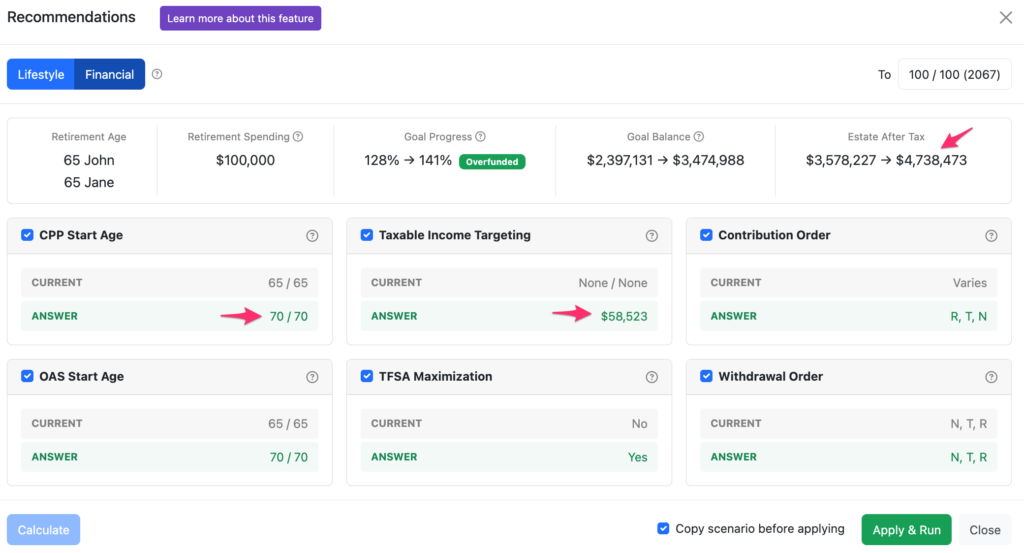
Show options and optimize client outcomes with Lifestyle and Financial Recommendations. Instantly answer questions such as, “When should I take my CPP?” with transparency and control over the plan. Click here to start a 14-day Free Trial of Snap Projections.
Where AI does fit in financial planning
None of this means advisors should avoid AI.
In fact, AI can provide tremendous value when used appropriately.
Examples include:
- Summarizing client documents
- Extracting information from statements
- Drafting meeting notes
- Preparing follow-up communications
- Identifying missing information
- Automating repetitive administrative tasks
- Creating first drafts that Advisors review and verify
These applications help improve efficiency while allowing the advisor to maintain control over the planning process.
The distinction is important:
AI can support the Advisor’s work.
It should not replace the Advisor’s professional judgment.
Learn how Canadian Advisors use AI in their financial planning process
FP Canada’s Rule 29 requires CFP® professionals to understand the methodologies and assumptions behind the technology they use, validate the inputs that drive recommendations, and verify the outputs before relying on them.
When ChatGPT is used as the primary tool for generating financial plans and recommendations, meeting these obligations becomes significantly more difficult because the model’s methodologies, assumptions, and reasoning are not fully transparent.
For that reason, AI is best viewed as an assistant rather than a Planner.
The most effective use of AI in financial planning is not replacing professional judgment—it is helping Advisors spend less time on administrative tasks and more time applying the expertise, analysis, and client-specific judgment that professional standards require.
Learn how other Canadian Advisors are leveraging the power of AI in financial planning the right way.